The Carmichael
The Carmichael have everything an old-money family could want. Except freedom.
Scotland, 1678
The Carmichael fortune began with Alistair Carmichael, the second son of a minor Scottish landowning family. Rather than waiting for the family estate to provide him with a future, Alistair left Scotland in his twenties and established himself as a merchant between Glasgow, London, and the ports of Northern Europe.He traded whatever was profitable: wool, timber, grain, textiles, and eventually precious silvers. Alistair understood something his older relatives did not. A man did not need to own the most land if he controlled the movement of goods across it.By the 1700s, the Carmichael name had become associated with maritime commerce and private lending. Alistair began lending money to merchants whose businesses were considered too risky for traditional banks.Some failed but others became extraordinarily successful. Alistair profited from both. By the time of his death in 1700, the Carmichaels were no longer merely a minor Scottish family. They become a wealthy family in London.
London, Early 1700s
After Alistair Carmichael's death, his fortune passed to his three sons: Edmund, William, and John Carmichael. The eldest, Edmund, inherited the family's commercial interests and became the head of the family. William inherited the family's London residence and a considerable portion of their private accounts.The youngest, John, had little interest in either inheritance or business. He was content with the monthly allowance provided by his brothers and preferred to spend his days pursuing his own pleasures.In 1705, Edmund's eldest son fell gravely ill with a disease that even the most accomplished physicians in London could neither identify nor cure. For an entire year, the boy's condition deteriorated, leaving Edmund with little hope of seeing his son recover. During that same year, Edmund's wife, Marjorie, suffered two miscarriages.As the months passed, the family began to fear that the two tragedies were somehow connected. John, notorious for his reckless habits and numerous affairs, happened to spend a night with a woman who claimed to be a witch. Before dawn, she told him a story about men who had once made bargains with them in exchange for wealth, influence, and prosperity.John had always suspected that his father's fortune had not been acquired through honest commerce alone. For years, Alistair's sudden rise from a minor Scottish landowner to a wealthy and influential merchant had never made complete sense to him.The witch's story gave those suspicions a new shape. John spent months trying to find her again. When he finally succeeded, she revealed something far more disturbing than he had anticipated. Alistair had indeed made a bargain. And the bargain had passed to his descendants.According to the terms of the pact, Edmund's eldest son had to be sacrificed if Edmund was ever to father another child. If the boy lived, Marjorie's pregnancies would continue to end in miscarriage. The bargain demanded blood from the Carmichael bloodline.Edmund refused to believe it at first. But after witnessing his son's suffering for an entire year, his desperation eventually overcame his reason. He agreed to perform the ritual.The boy was sacrificed.His death was followed by a silence that settled over the Carmichael household like a funeral shroud. Marjorie eventually learned the truth. Upon discovering that her own husband had sacrificed their son, she was unable to bear the grief. Broken by the loss, she took her own life.Edmund never recovered from what he had done. Within a few years, his mind deteriorated completely. He withdrew from society, abandoned his responsibilities, and eventually became incapable of managing the family's affairs.William was forced to take control of the Carmichael estates and businesses. But he and John soon discovered that the bargain could not simply be broken.They sought every means available to sever the family's connection to them. Priests were consulted. They studied old manuscripts, performed ridiculous rituals, but nothing worked. Eventually, they learned the final condition of the pact.The bargain could only be broken when every descendant of Alistair Carmichael was dead.Until then, the Carmichael fortune would continue to grow. Every generation would become wealthier than the one before it. Their influence would spread further. Their name would become increasingly powerful.But the family would pay for its fortune in blood. Every firstborn son born to a Carmichael descendant would die before reaching the age of three.It did not matter how many times the family remarried. It did not matter who their spouses were or where they came from. The curse followed the bloodline. Every Carmichael couple who produced a firstborn son would eventually lose him.Unable to accept the reality, William and John decided to accept that condition. And so the family prospered. Their influence reached further into London's highest circles. Generation after generation, the Carmichaels became richer and more powerful.
The Following Centuries
The centuries that followed saw the Carmichaels grow far beyond the fortune Alistair had left behind.Throughout the eighteenth century, the family expanded from private lending and maritime commerce into banking, land acquisition, shipping, and trade. They married into other wealthy families, purchased estates across Britain, and slowly established themselves among London's most influential circles. Every generation brought wealth, influence, and another firstborn son destined to die before his fifth birthday.By the nineteenth century, the Carmichaels had begun investing in the industries reshaping the modern world: railways, steel, coal, manufacturing, and later oil and telecommunications. Their wealth crossed the Atlantic, establishing a permanent presence in the United States.The family became patrons of universities, hospitals, museums, and charitable institutions. Their name appeared on buildings and foundations across Britain and America, creating a respectable public legacy that concealed the darker history beneath it.The twentieth century brought wars, financial crises, political upheaval, and the gradual disappearance of many old aristocratic fortunes. Yet, the Carmichaels survived them all.They diversified their wealth into private banking, real estate, investment firms, energy, technology, and private equity. The family stopped relying on individual businesses and instead accumulated ownership across entire industries. Through marriages, business alliances, and carefully maintained relationships, their influence continued to grow.Generations of Carmichael mothers gave birth to firstborn sons, celebrated their arrivals, and buried them before their fifth birthdays.The family stopped questioning about it. Eventually, the deaths became something discussed only behind closed doors, mourned in private and never mentioned outside the bloodline.
The Great Recession, 2007–2009
When the global financial crisis began to unfold in 2007, the Carmichaels recognized the danger earlier than most.The family had spent centuries studying credit, markets, and the behavior of wealthy institutions during periods of panic. As the housing market deteriorated and financial markets began to seize, the Carmichael Office quietly began moving capital.While banks and investors struggled with collapsing asset values and frozen credit markets, the Carmichaels provided private capital to several institutions and businesses that were considered too unstable for conventional lenders.When Lehman Brothers collapsed in September 2008 and the crisis intensified, the Carmichaels became even more active behind the scenes. Governments and central banks were already taking extraordinary measures to prevent the financial system from collapsing, but the family used its own private network to provide liquidity where it could.Several businesses that would otherwise have disappeared received quiet financing from Carmichael-linked funds. A number of companies were allowed to restructure rather than collapse. Properties that had been abandoned were purchased and held until the market recovered.The family also increased its charitable giving during the recession, publicly presenting it as humanitarian support for communities affected by unemployment, foreclosure, and the collapse of local businesses.By the time the worst of the recession had passed in 2009, the Carmichaels had emerged considerably stronger than before. Some of the assets acquired during the crisis would eventually become among the family's most valuable holdings.The public never knew the extent of their involvement. To the world, the Carmichaels had simply endured another financial crisis.
Present Days
Today, the Carmichaels remain one of the most established old-money families of their generation. Their wealth has survived long enough to become difficult to measure, spread across generations of investments and assets rather than belonging to any single company or individual.The family's estates remain occupied. Their foundations continue to operate. Their name can still be found among the boards of prestigious institutions and the guest lists of Britain's most exclusive circles.The Carmichaels have everything an old-money family could want.
Except freedom.
Carmichael Land & Property
Carmichael Land & Property is responsible for acquiring, developing, managing, and investing in properties across the world. Their portfolio includes; residential properties, commercial properties, hospitality, land ownership and urban development where they partnered with governments.
Carmichael Private Capital
Carmichael Private Capital manages investments, financial assets, and private capital for the family and few selected clients. Its operations includes; private equity, asset management, private banking, venture capital and corporate financing.
Carmichael Resources
Carmichael Life Science invests in and develops emerging technologies, scientific research and medical innovation. Their pharmaceuticals operations develop, manufacture and distribute drugs. Biotechnology and medical technology focuses on genetic research, advanced medical treatment, surgical technology and healthcare innovations. Artificial intelligence and information technology focuses on cybersecurity, AI development, machine learning and data infrastructure. Their scientific research funds universities, private laboratories and independent research institutions.
Carmichael Life Science
Carmichael Resources focuses on the energy and infrastructure industries such as oil and natural gas. They also have renewable energy like wind farms and natural resources like mining and mineral extraction. Other than that, they build transportation infrastructure starting from ports, railways, and logistics facilities.
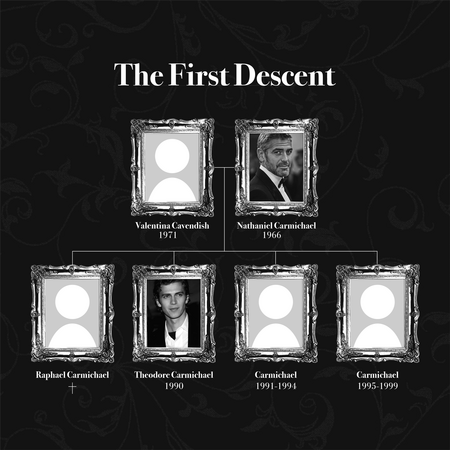
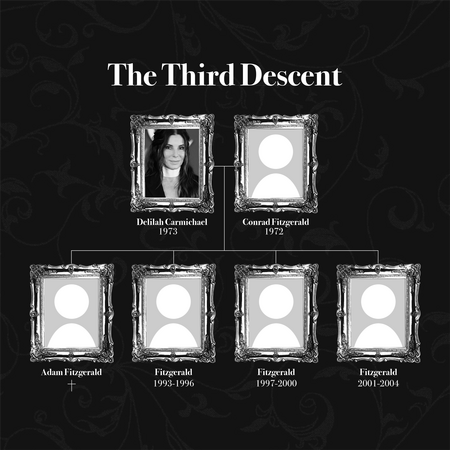
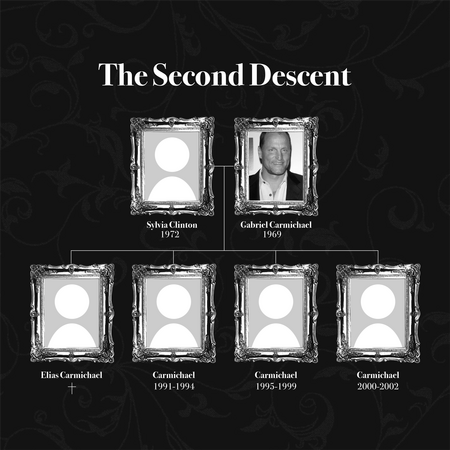
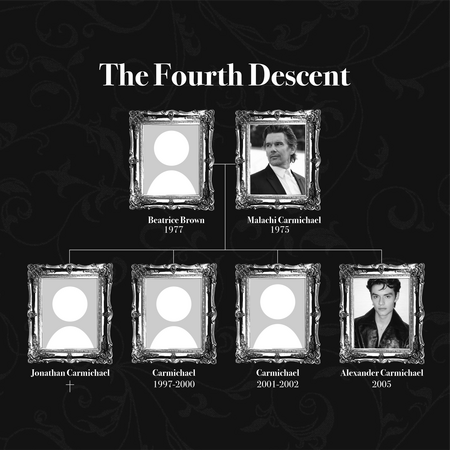
Carmichael Family Tree